
Support
The NDIS SDA Rules, Price Guide and other documents will inform the delivery of support e.g. provision of onsite overnight assistance (OOA); the maximum number of residents in SDA housing types.
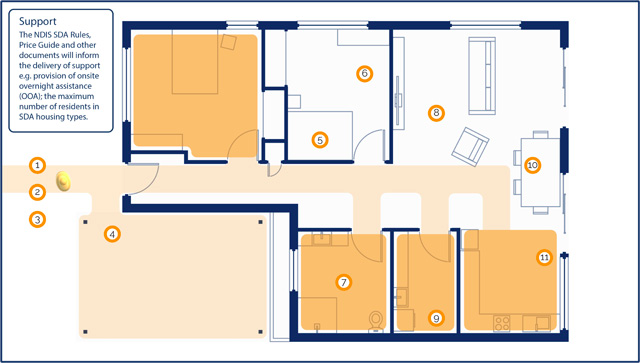
1 | In units, villas or townhouses, line of sight support may not always be provided if onsite assistance is shared across multiple dwellings. Options to call for support via assistive technologies, or to manage independence without line of sight at all times, will be required (refer Assistive Technology notes also). |
2 | Provision of units or villas with a support hub may allow for smaller outreach space for staff within individual dwellings. |
3 | If multiple SDA villas are located on one site support staff may be required to move between dwellings during the day and night – consideration of support staff safety is required. |
4 | Consider undercover access from car parking to dwelling when a tenant has support needs relating to vehicle transfers and transport. |
5 | There may be opportunity to live with a co-tenant in a villa, depending upon number of bedrooms and internal space available – living with others may offer incidental social interaction. Living alone will require a person to plan for social interaction in their home (with visitors) or the community (by visiting others). |
6 | Villas, units or townhouses may be provided with or without onsite overnight assistance (OOA) space, which is defined as an additional room inside or adjoining the dwelling (refer SDA price guide). |
7 | Provision of second, separate bathroom or powder room may allow visitors or co-tenants to use that bathroom whilst at the same time allowing delivery of support in the main tenant’s bathroom. |
8 | In a smaller dwelling size, design and support should reconsider privacy when some spaces are heavily supported (e.g., lounge and TV area may become ‘more’ private than a bedroom). |
9 | Laundries may be stand-alone, or located in bathrooms or provided as a European laundry, in smaller dwellings. Consider timing of support delivery for laundry when the space is not in use for other daily activities (e.g. bathing or toileting). |
10 | Choice of furniture will affect reach, access, and mobility and hence the need for support. Close consideration of furniture layout to maximise independence is necessary. |
11 | Use of bench-top storage, small modular drawers, or a mobile workbench may allow ease of access to items used daily by a tenant, and thus reduce need for support in work areas (e.g., bathroom, kitchen). |

