
Technology
Assistive Technology (AT) can include a wide range of installations, mainstream or specialised technologies or equipment. AT assists completion of daily activities with maximum independence.
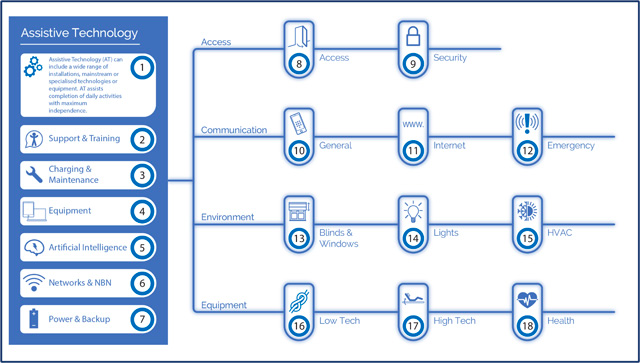
1 | The World Health Organisation defines assistive technology (AT) as devices and technologies ‘whose primary purpose is to maintain or improve an individual’s functioning and independence to facilitate participation and to enhance overall well-being’. See http://www.who.int/disabilities/technology/ en/. AT includes ‘products which enable activities and participation, and the services which support their application and use’. See http://www.arata.org.au/about-at/. AT can range from basic to highly complex - see https://www.ndis.gov.au/providers/assistive-technology . In built design, AT may include simple solutions like grab rails to walls, or a rope to a cupboard door, as well as customised solutions such as ceiling-mounted hoists or home automation systems. |
2 | ‘Soft technology’ is human support and training for effective use of assistive products, and can reduce the required level of support over time (Waldron & Layton, 2008). This support may be provided by peers, family or friends, support workers, AT specialists, suppliers or health professionals. Support and training, including cost and funding implications, should be closely considered and planned for when implementing new AT. |
3 | Maintenance and routine service calls, as well as response times and costs of repair, should be planned for when implementing AT. Back-up options for environmental control, communication systems, or mobility aides should also be identified. Investigating service contractors who can respond during business hours, as well as on weekends or after hours may be necessary. |
4 | AT equipment can include devices, equipment, instruments or software, specifically designed or generally available. The primary purpose of AT equipment is to maintain or improve an individual's functioning and independence, but it may also be used to prevent impairments and secondary health conditions. See http://www.arata.org.au/about-at/ |
5 | Artificial intelligence (AI) offers connection of the home environment and the people inside it, using integrated ambient intelligence (e.g. movement or other sensors, automatic dialers), technology learning, affective computing, and robotics (Bramer, 2006, p.427). AI is increasingly being used in housing to identify typical vs out of the ordinary events, and may trigger scenarios, actions or responses. AI products, increasingly available via the mainstream technology market, may offer options to assist, or potentially replace, human supports. Privacy issues relating to use of video or photography, versus infrared movement sensing, should be considered. |
6 | Integration of technology in smart housing design must consider hard wired vs wireless Internet options, including access to the National Broadband Network (NBN), and dwelling-based vs external network access. Networks and Internet access may be affected by environmental factors (e.g. flooding; fire). Alternate home automation and communication systems may be necessary. |
7 | Changing electricity requirements, including supply and backup systems, must be considered. Emergency solutions should be provided to cater for power outage, particularly where the welfare of tenants is at risk. A back up generator may be required for the operation of elevators or doors if power supply fails. Customised access to power banks, docking stations and other flexible sources can help build tenant independence. |
8 | Home automation technologies can allow independent control of access to the home via external doors and gates, as well as control of internal doors. Door access may be controlled via single switch solutions such as a fob, or via multi-feature App controls such as a smartphone or tablet. Timing of automated door opening is important for security and for safe entry or exit when using a mobility device. Home automation technology offers the capacity to log frequency and type of use by a tenant, with consent, to inform discussion of low or high usage and potential for further options. |
9 | Video intercom systems, accessed by wall mounted panel, smartphone or tablet, can allow a tenant to see and communicate with the person they are letting into their home. |
10 | Communication technologies can be used to access human support as required, and also offering privacy from support staff. Communication technologies may include ceiling-mounted speakers linked to a support hub; messaging or calls via mobile telephone or landline; the use of Facetime or other videolink; or single call buttons or intercoms. |
11 | Internet communications may be accessed via home or mobile broadband. Data allowances, bandwidth and speed is a necessary consideration if independent living relies on high levels of internet connectivity or usage. Internet and data affordability should also be considered. Capacity to access free community wifi (e.g. at a library or café) can assist affordability of software updates for portable internet-enabled devices, like laptop computers or tablets. |
12 | Communication technologies that offer prompt, reliable emergency response may need to be separated from everyday devices. Back up systems or options are vital, particularly for a person with support needs that may require urgent emergency response. A hierarchy of communication responses and associated actions (e.g. calling GP vs an ambulance) should be established, based on an individual’s support needs. A testing schedule of emergency communication systems should be established, documented and maintained. |
13 | Automation of windows allows for independent control of both ventilation and external noise. Providing power supply to windows as part of the base build allows for easier retrofitting of blind and window automation. Home automation technology offers the capacity to log frequency and type of use by a tenant, with consent, to inform discussion of low or high usage and potential for further options. |
14 | Home automation technologies can allow remote operation of lighting, windows or other features when the tenant is offsite or prior to arrival home. Lighting selection and installation can offer control via home automation systems, options may be provided for as part of the base build. Lighting may be controlled via standard light switch, large button switch or wired smart technologies. |
15 | WIFI-enabled split systems can offer control via home automation systems. Home automations technologies can assist opening and closing windows remotely to manage temperature and noise. |
16 | Low tech equipment can be used by a tenant to build independence at home. This equipment may include pick up sticks, simple attachments to taps or handles to assist reach and access, or low cost items such as basic shower chairs or grab rails. |
17 | High tech equipment may be built into a home (e.g. a ceiling track hoist, hydraulic bathtub) or portable (e.g. a motorised wheelchair or prosthesis). This equipment may require customised prescription by a specialist AT consultant or health professional. |
18 | Health technologies may include temperature, heart rate, blood glucose or other health monitoring. Options for health technologies that record health outcomes (e.g. blood pressure monitor), vs those that may respond to health anomalies (e.g. insulin pump therapy) should be considered. Smart technologies may be used to manage health such as by prompting a person to stay hydrated or take medication; of by maintaining a consistent temperature in the person’s home). |

