
Support
The SDA Price Guide and other documents will influence the delivery of support such as onsite overnight assistance (OOA); the maximum number of residents in SDA housing types - refer to current NDIS SDA Price Guide.
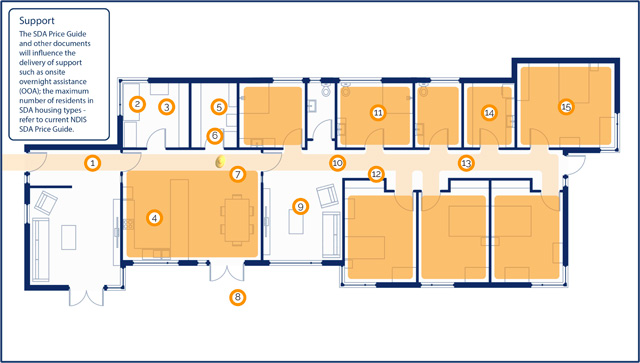
1 | Group homes may necessitate the delivery of support for domestic tasks (e.g. laundry, cleaning) for multiple tenants – consider tenant preference for targeted individual support or nominated individual domestic activity times to build participation. |
2 | Consideration of secure storage areas will be necessary (e.g. medication, health information) – storage may be located in a dedicated support staff space, which may also offer a private area for onsite overnight support. |
3 | Human supports may be complemented by use of assistive technology (refer Assistive Technology notes also). |
4 | The kitchen may become an area of heavy use, and necessitate support for a number of people with disability to participate in meal preparation. Consider designing to accommodate access by a range of users and support persons. |
5 | A separate pantry room/space can allow graded access to food if required. |
6 | Dedicated accessible space will be needed for storage and charging of support equipment (e.g. portable hoist; wheelchair; mobile shower commode). |
7 | The person in receipt of support should be assisted, wherever possible, to participate in the recruitment and training of support staff. |
8 | Access to outdoor living may offer retreat spaces for tenants to manage behavioural support needs or facilitate privacy/reduced stimulation. |
9 | In group living, options for privacy may be limited to some living spaces, outdoor areas, or a person’s bedroom (which is also where support is delivered). |
10 | Support staff are required to move across different areas of a group home to deliver support to multiple tenants – consider requirement for urgent delivery of support in the built and technology design (e.g. circulation, emergency response). |
11 | Provision of a number of accessible bathrooms or powder rooms will be necessary in a group home so personal care support may be delivered to more than one tenant at a time. |
12 | Reliance on human supports may be reduced via the consistent use of external cognitive aids (e.g. checklists, orientation materials, prompts). |
13 | Interior corridors and exterior spaces can be useful for physical maintenance and capacity building programs related to health and wellbeing. |
14 | When body fluids require management, minimise risk of cross infection by individualising support (e.g. individual laundry, enteral feeding equipment, continence management). |
15 | In robust design group homes, a ‘break out’ room (a separate room designed to respond to the individual disability related needs of the participant) may be provided for support staff (refer SDA price guide). |

