
Tenant Experience
As part of this project, we met with people living in a range of housing types and design categories of Specialist Disability Accommodation. We talked to them about their individual experiences of housing, their support needs, and participation in home and community life. We completed a published measure of support needs(i). We talked to them about their experience of setting up the house, and the activities they undertook in and around the home. We asked people to explain and demonstrate the features they found useful, and those identified as barriers, in their experiences of the home. With the permission of participants, we also spoke to family and support staff. Key things to consider as a result of our findings are listed below.
i. Tate, R. (2004). Assessing support needs for people with traumatic brain injury: The Care and Needs Scale (CANS). Brain Injury, 18(5), 445–460.
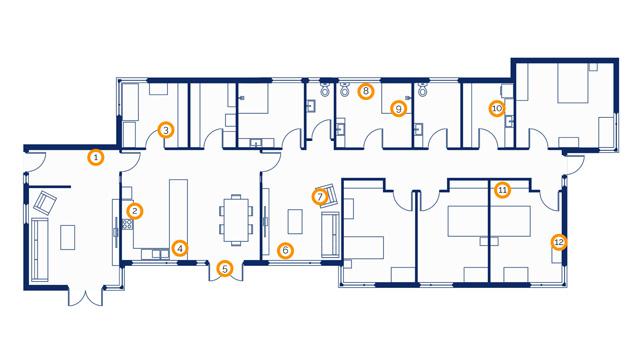
1 | Accessible home environment offers the capacity to develop skills + build independence. |
2 | Joinery may need to be customised for individual’s reach + access. |
3 | Plan location of tenant information to ensure privacy + staff access. |
4 | Items that are used often should be placed within easy reach. |
5 | Connection of interior and exterior spaces can support a range of uses. |
6 | Consider use of natural light to manage thermal + visual comfort + utility costs. |
7 | There are potential conflicts between expectations of ‘homelike furnishing’ versus functional use for resident. |
8 | Installation of additional handrails can be more flexible with plywood lining behind wall finishes. |
9 | Consider location of tap for reach by tenant + support staff. |
10 | Site + glazing orientation can offer low-cost clothes drying options. |
11 | Consider need for human support vs external cognitive aides to assist independence with dressing. |
12 | Use of bedroom as private space may be required for extended periods. |

