
Assistive Technology
The World Health Organisation defines assistive technology (AT) as devices and technologies with a primary purpose ‘to maintain or improve an individual’s functioning and independence to facilitate participation and to enhance overall well-being’(i).
AT includes ‘products which enable activities and participation, and the services which support their application and use’(ii). AT can range from basic to highly complex(iii).
As part of this project, we met with people living in a range of building types and design categories of Specialist Disability Accommodation (SDA). We talked to them about their experience of technology in housing, as well as completing two measures of their satisfaction with technology design and services(iv) and use(v). We also spoke to family and support staff. Some key considerations for assistive technology use are listed below – please also refer to Technology Detail notes below.
i. http://www.who.int/disabilities/technology/en/
ii. http://www.arata.org.au/about-at/
iii. https://www.ndis.gov.au/providers/assistive-technology
iv. Demers, L, Weiss-Lambrou, R. & Ska, B. (2002). The Quebec User Evaluation of Satisfaction with Assistive Technology (QUEST 2.0): An overview and recent progress. Technology and Disability, 14, 101-105.
v. Jutai, J. & Day, H. (2002). Psychosocial Impact of Assistive Devices Scale (PIADS). Technology & Disability, 14(3), 107–111
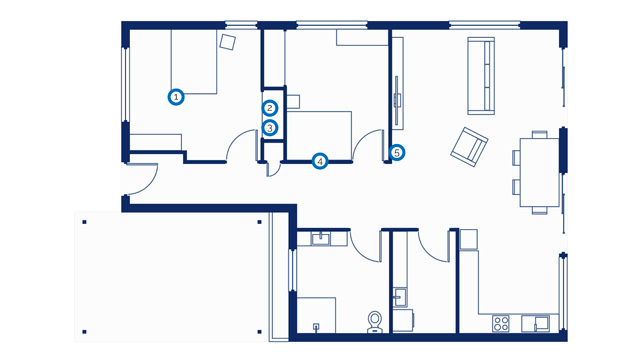
1 | Recessed hoist ceiling track offers flexibility over time. |
2 | Power points in walk-in robe allow for private charging of mobility devices. |
3 | Consider storage needs + location for personal care / additional mobility equipment. |
4 | Installation of 12mm plywood lining behind tiles allows for installation of additional handrails specific to tenant’s requirements. |
5 | Large format light switches + GPOs may offer faster control of environment compared to mobile/tablet interfaces in small spaces. |

